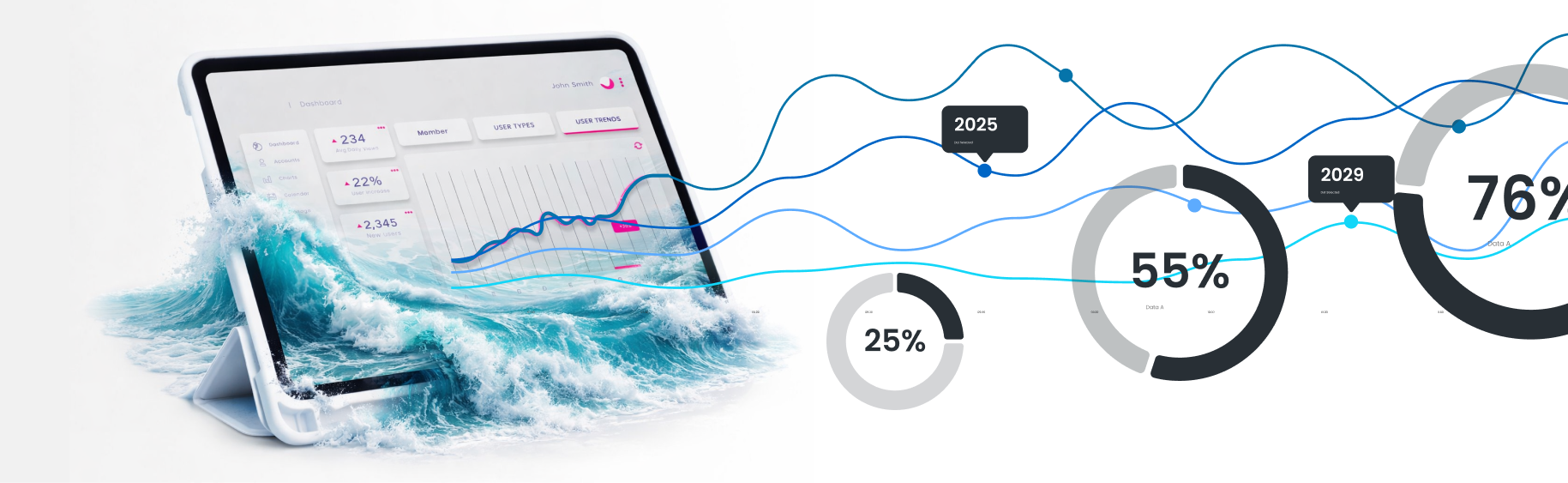

By integrating environmental, social, and economic data, the IMDT will give users powerful tools to analyse ecosystem behaviour, management options, and ecosystem-service dynamics, both in real time and through forecasts. Each demonstration site will host its own IMDT instance (T5.6 and T6.1), tailored to local conditions through a flexible knowledge-base model (T5.2). Running in the cloud, these IMDTs will continuously ingest diverse data streams and transform them into key indicators, which will be analysed using AI, machine learning, and advanced big-data techniques. This will enable automated assessments of ecological performance, sustainability, and restoration outcomes while supporting scenario simulations and decision-making.
The IMDT will integrate real-time monitoring (WP2), processed data (WP2/3/4), open-access datasets (T2.1), and numerical models (WP3/4) to represent ongoing changes and test future scenarios such as restoration measures, policy decisions, or new regulations. It will also link to the BlueCloud2026 framework and incorporate additional data sources to ensure long-term usability, replication, and scalability across regions.
These efforts will deliver functional IMDT prototypes that serve as data-driven decision-support systems, combining intuitive visualisation, rich analytics, and conversational AI. By modelling factors such as underwater noise, climate change, and ecosystem services, the IMDT will allow managers to compare scenarios, reduce risks, and strengthen resilience. Users will interact with the system through multimodal interfaces, accessing vivid representations of each OMA’s physical, acoustic, genetic, biological, and socio-economic dimensions—with forecasts ranging from seasonal patterns to long-term trends.
The IMDT will also act as a key tool for public engagement and citizen participation. Different stakeholder groups—from managers and researchers to fishers and local communities—will access tailored insights, open data, and site-specific management information. SEAMPHONI will complement this by mobilising local actors (T8.2) and sharing knowledge widely (WP8), encouraging active involvement in protecting marine ecosystems. Through co-mapping exercises, feedback channels, and mobile and web applications, citizens and MPA managers will help assess ecosystem services and contribute to local restoration efforts. By involving communities directly in these nature-positive innovations, SEAMPHONI aims to strengthen support for strict protection measures and boost local ownership of restoration goals.