At each site, SEAMPHONI will carry out two offshore research cruises (CR1 and CR2), spaced one year apart. Along the route from coastal waters to the high seas, often crossing areas with different protection levels, the teams will collect eDNA, acoustic recordings, and visual data. During the first cruise, key instruments such as acoustic sensors and automated eDNA samplers (selected under T2.2) will be deployed and left in place for roughly a year. This approach ensures consistent baseline information and robust time-series data, while still allowing each site to take advantage of its own infrastructure and scientific strengths. For example, Spain and Madeira will contribute megafauna satellite tracking, and La Réunion will leverage its capacity for three offshore expeditions per year and its advanced cytometric tools for food-web analysis.
In Madeira, GEOMAR will lead a three-week expedition using Germany’s large research vessel fleet to deploy high-end sensors for biodiversity assessments and habitat mapping. These measurements will help calibrate and validate SEAMPHONI’s lower-cost tools and support detailed food-web sampling described later in this section. With NORCE’s support, the project will also build on data from the Norwegian One Ocean Expedition 1 (OOE1), already completed, and OOE2 (2025–2026), which together provide valuable eDNA and baseline biodiversity information across multiple ocean regions.
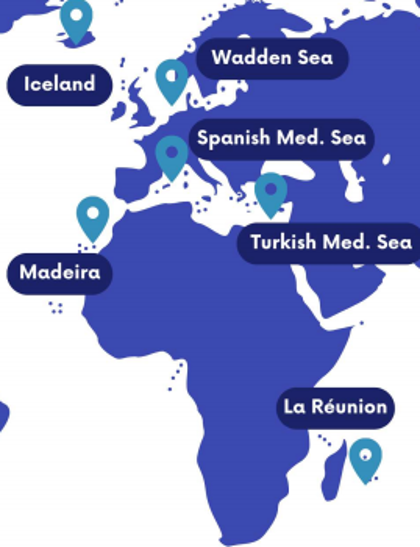
SEAMPHONI’s monitoring methods and the Intelligent Marine Digital Twin (IMDT) will be tested and validated at six demonstration sites, covering a variety of marine habitats, ecosystem services, climate risks, and blue economy sectors.
The table below outlines these aspects and shows how SEAMPHONI meets user needs.
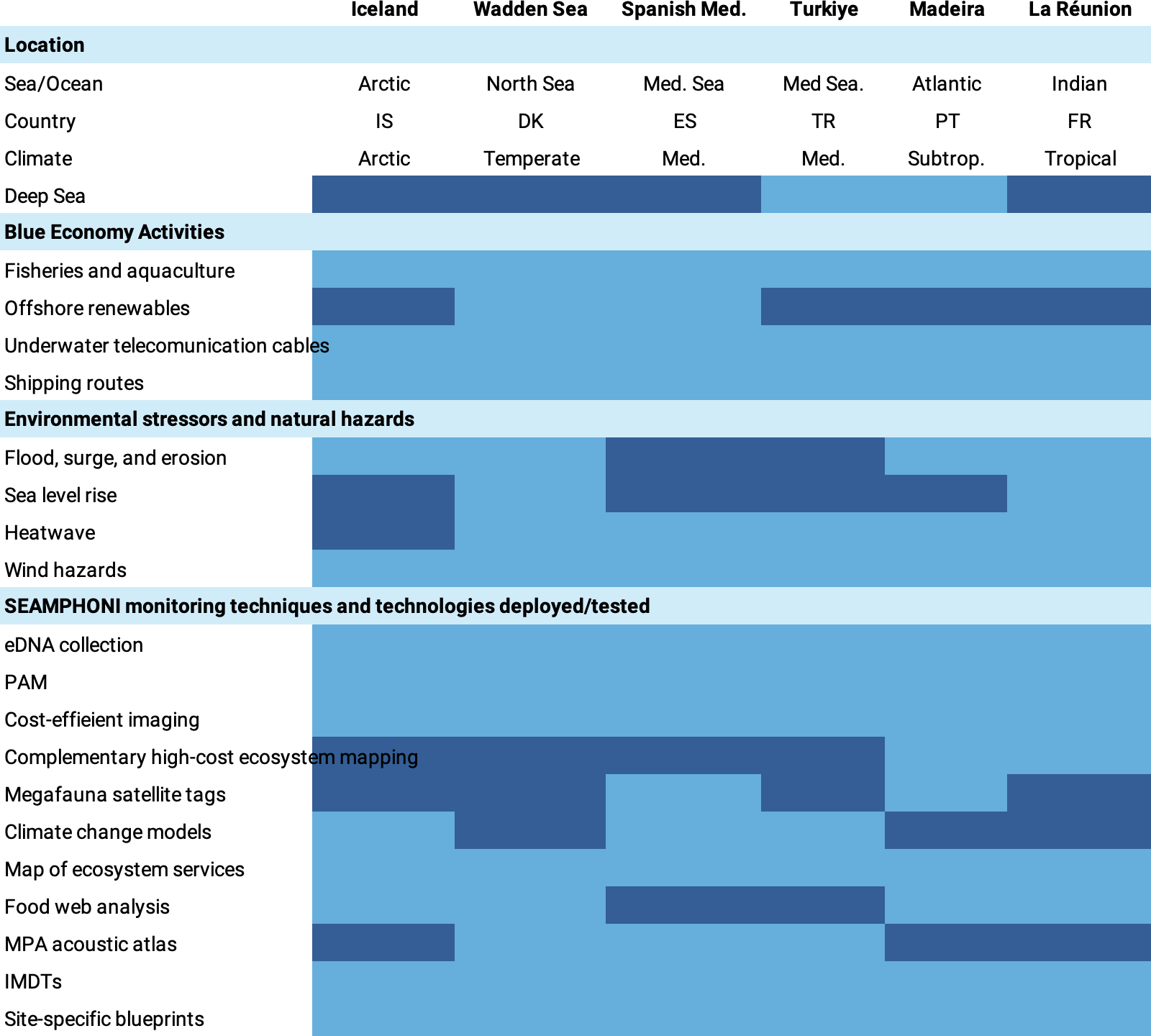
Summary of SEAMPHONI demonstration sites. Coloured tags indicate that the characteristic is relevant (light blue) or not relevant (dark blue) to that site.